NT$ 11,900
Home » Modular Synthesizer » Filter » INSTRUŌ I-ō47
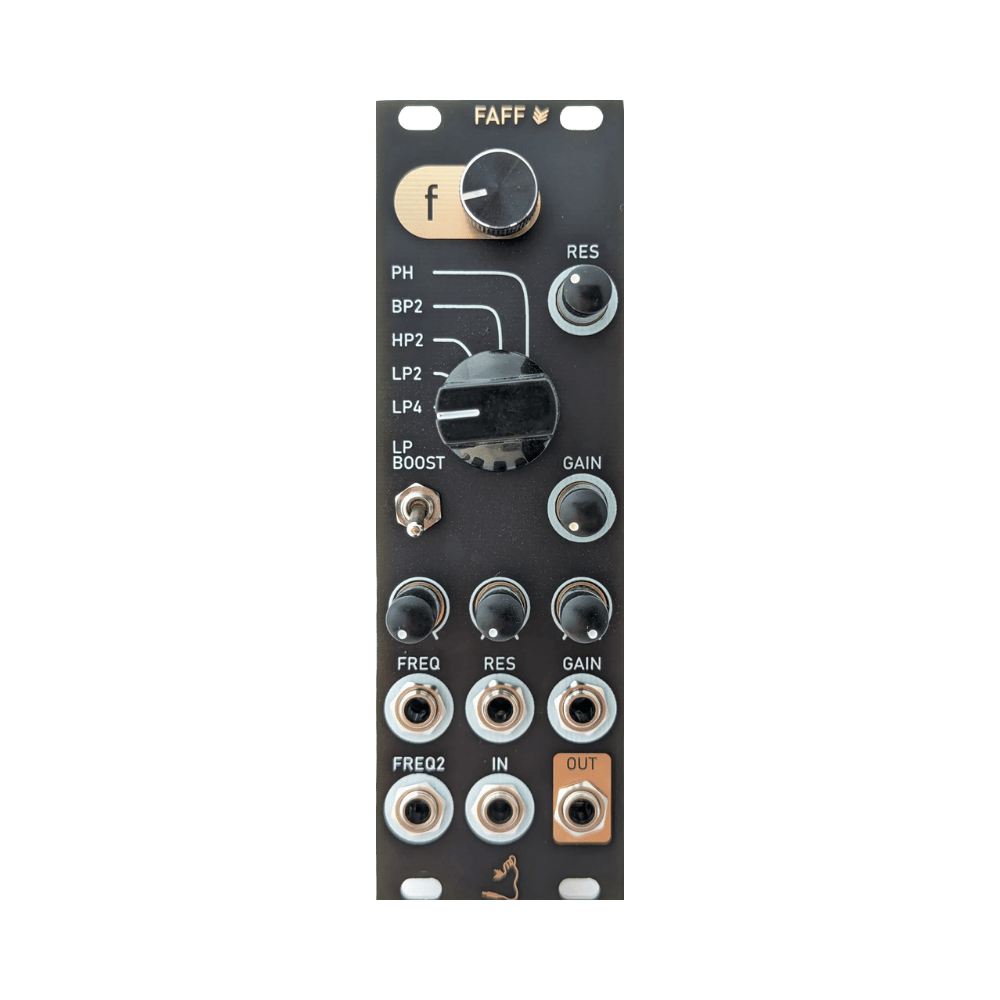

I-ō47
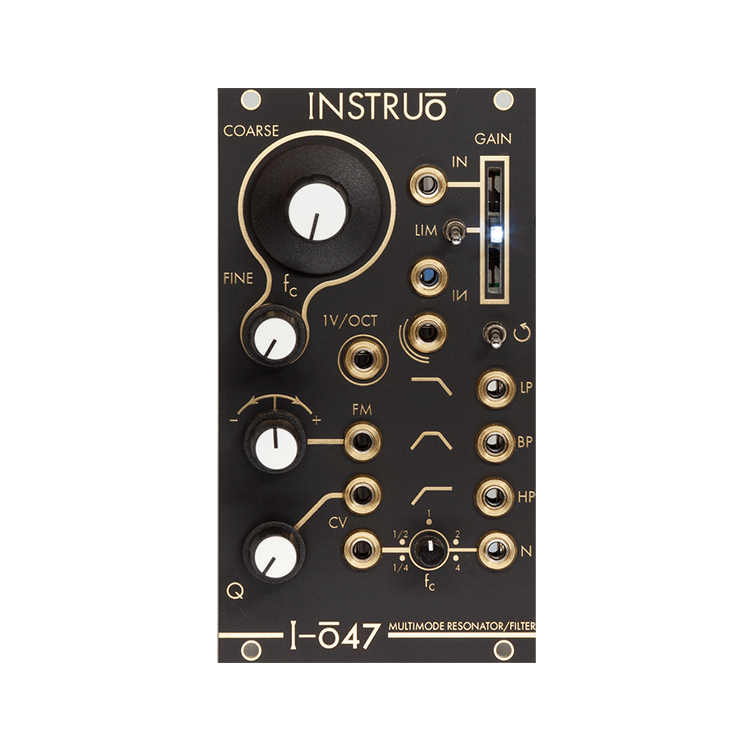
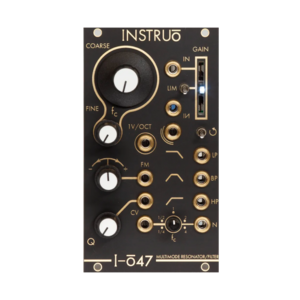
I-ō47 Multimode Resonator/Filter is a modern take on a vintage circuit design inspired by the classic 1047 module of the ARP2500. It has been designed with some extra features and quirks built in.
The internal VCA’s are a new hybrid design of matched transistors and precision op-amps.
With CV controllable centre frequency, resonance/Q and notch offset along side FM, strike and a complex dual input with wave shaping limiter, the I-ō47 is truly a filter for all occasions.
I-ō47 | ʌɪ-əʊ-ˈfɔːti-ˈsɛv(ə)n | noun (signal processing) the in’s and out’s of a classic multimode filter/resonator
Description
Size
14HP
Depth: 27mm
Power
+12V: 50mA
–12V: 50mA
Specifications
- Centre frequency range 16Hz to 16KHz
- 1V/octave, Coarse and Fine frequency controls
- FM input with attenuverter
- Low pass 12 dB/octave
- High pass 12 dB/octave
- Band pass 6 – 12 dB/octave dependent on Q
- Notch with variable offset –/+ 2 octaves
- Input with gain control
- Inverted input with resonance dependent gain
- Strike input for pinging the filter
- Feedback switch which adds BP to the input for enhances resonance
- Limiter based on tanh wave shaper which affects primary input (post gain fader)
Description
I-ō47 Multimode Resonator/Filter draws its circuit design inspiration from the classic 1047 module of the ARP2500 system.
Built upon the classic circuit architecture of the original, the design was refined with extensive experimentation using modern components along side classic configurations of discrete parts.
The internal VCA’s are a new hybrid design of matched transistors and precision op-amps.
Various refinements were also added such as voltage control over the variable notch offset which opens new worlds of dynamic sweeps and shaping.
There are two audio inputs on the I-ō47. The top runs through a gain stage, set by the fader, and has an optional limiter in line with it selected by the LIM toggle switch.
This limiter is an implementation of the tanh wave shaper circuit which applies the soft curvature of the tanh expression to any input signal. The gain fader sits before the limiter allowing for precise control over the amount of warm saturation that occurs with this style of limiting.
With a simple sawtooth wave, the limiter will gently curve the ramp and result in subtle enhancement of the low end of the signal’s tone.
For more complex audio signals (drum voices work a treat!) the limiter will give very musical results akin to gentle compression/overdrive, all the way to limiting and saturation.
The inverting input inverts the polarity of the input signal. This input is also directly affected in amplitude by the Q (resonance) control. As resonance increases, the signal amplitude will decrease, acting as a form of automatic gain compensation.
Both inputs can be used simultaneously to mix two independent audio signals.
The variable Notch effectively crossfades between branches of the low-pass and high-pass signals. The result is an offset notch response that can shift up or down a couple of octaves from the centre frequency.
This part of the circuit was inspired directly from the 2500’s 1047 variable notch control.
CV was added by means of an optimised linear crossfading VCA pair. (The versatility of the variable notch output became apparent early on in development, so CV control was made a priority!)
Q (resonance) is CV controllable.
The feedback toggle sends an additional branch of the band-pass signal to the non-inverting input and allows for stable self oscillation of the Filter. It can be used to kick the resonance response up a gear.
The strike input can be used to ‘ping’ the resonance of the filter. It is designed to respond to signals at audio rate which allows for its use as an input for square wave tones.


Reviews:
Purchase FAQ
Q1. What is the inspection period?
According to the Consumer Protection Act, online purchases come with a 7-day inspection period starting from the delivery date. Please note that the "inspection period is not a trial period." The purpose is for you to inspect and review the product, not to use it. If you are unsatisfied after inspection, please do not open or use the product and follow the return procedures immediately. Returned products must be in complete packaging with all accessories, gifts, and original packaging intact. Any missing, damaged, or incomplete items may affect your return rights and restoration costs may be deducted.
Q2. How do I process a return or exchange?
If you wish to return a product, please ensure it is in complete, new condition with the original packaging undamaged. This includes the product itself, accessories, warranty card, original packaging, and all accompanying documents. If the product is damaged due to reasons attributable to you, we may not be able to process the return, or repair costs may be deducted from the refund. However, products with manufacturing defects are exempt and qualify for unconditional return or exchange.
Please contact us by phone or email within the inspection period, providing the reason for the return/exchange, current product condition, phone number, and pickup address. We will arrange the return within 3-5 business days.
Q3. How will I receive my refund, and how long does it take?
Refund methods and timelines vary by payment method:
Credit Card: After we receive the returned product, the refund will be credited to your credit card account within approximately 5-7 business days. Depending on your billing cycle, the refund may appear on your current or next statement. Please confirm with your credit card issuing bank.
Bank Transfer: Please contact service [at] digilog.tw with your complete bank details (bank name, branch name, bank code, account holder name, account number). We will arrange courier pickup of the returned product and transfer the refund to your designated account within 5-7 business days.
Q4. Do I need to pay for shipping when sending products for repair?
Round-trip shipping costs for product repairs are the customer's responsibility.
INSTRUŌ Others:
![INSTRUŌ tanh[3] INSTRUO 模組化合成器 - Modulation](https://dywzyq1lym3hh.cloudfront.net/uploads/product/cover/1713/thumb_Instruo_tanh.png)
-8%
Modulation
INSTRUŌ tanh[3] INSTRUO 模組化合成器
INSTRUŌ tanh[3] INSTRUO 模組化合成器
NT 5,990
Price
NT
5,490
NT 5,990
Price
NT
5,490
-10%
Granular
INSTRUŌ arbhar INSTRUO 模組化合成器
INSTRUŌ arbhar INSTRUO 模組化合成器
NT 25,500
Price
NT
23,000
NT 25,500
Price
NT
23,000
-9%
Envelope
INSTRUŌ cèis INSTRUO 模組化合成器
INSTRUŌ cèis INSTRUO 模組化合成器
NT 7,600
Price
NT
6,900
NT 7,600
Price
NT
6,900
-11%
Filter
INSTRUŌ I-ō47 INSTRUO 模組化合成器
INSTRUŌ I-ō47 INSTRUO 模組化合成器
NT 14,000
Price
NT
12,500
NT 14,000
Price
NT
12,500
-9%
Effects
INSTRUŌ Lúbadh INSTRUO 模組化合成器
INSTRUŌ Lúbadh INSTRUO 模組化合成器
NT 25,200
Price
NT
23,000
NT 25,200
Price
NT
23,000
-12%
Modulation
INSTRUŌ øchd LFO INSTRUO 模組化合成器
INSTRUŌ øchd LFO INSTRUO 模組化合成器
NT 7,800
Price
NT
6,900
NT 7,800
Price
NT
6,900
You may be interested in:

Mixer
Tiptop Audio MIXZ 混音器
Tiptop Audio MIXZ 混音器
Price
NT
3,690
Price
NT
3,690

Filter
XAOC Devices Belgrad
XAOC Devices Belgrad
Price
NT
12,900
Price
NT
12,900
-13%
Utility
Noise Engineering Muta Jovis
Noise Engineering Muta Jovis
NT 4,790
Price
NT
4,190
NT 4,790
Price
NT
4,190
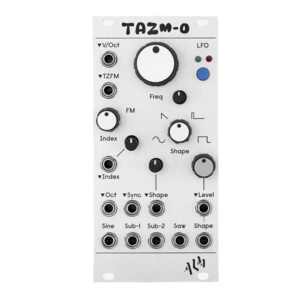
-8%
VCO
ALM Busy Circuits ALM036 TAZM-O: An...
ALM Busy Circuits ALM036 TAZM-O: An...
NT 13,590
Price
NT
12,500
NT 13,590
Price
NT
12,500
-9%
Effects
INSTRUŌ Lúbadh INSTRUO 模組化合成器
INSTRUŌ Lúbadh INSTRUO 模組化合成器
NT 25,200
Price
NT
23,000
NT 25,200
Price
NT
23,000

Utility
XAOC Devices Erfurt
XAOC Devices Erfurt
Price
NT
6,400
Price
NT
6,400
 What's New
 Brands
 Rental
目前尚無評論