NT$ 7,900
Home » Modular Synthesizer » VCO » Mutable Instruments Plaits
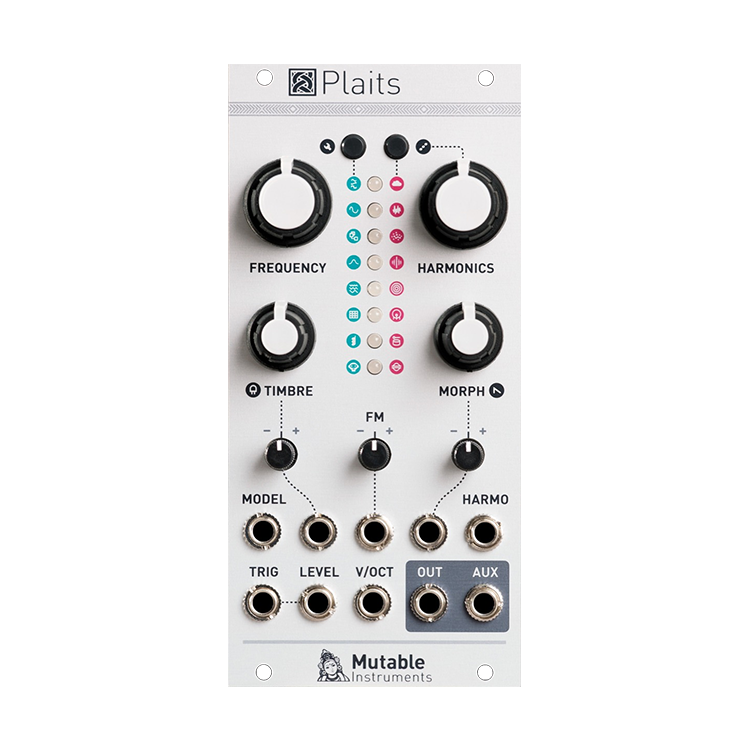
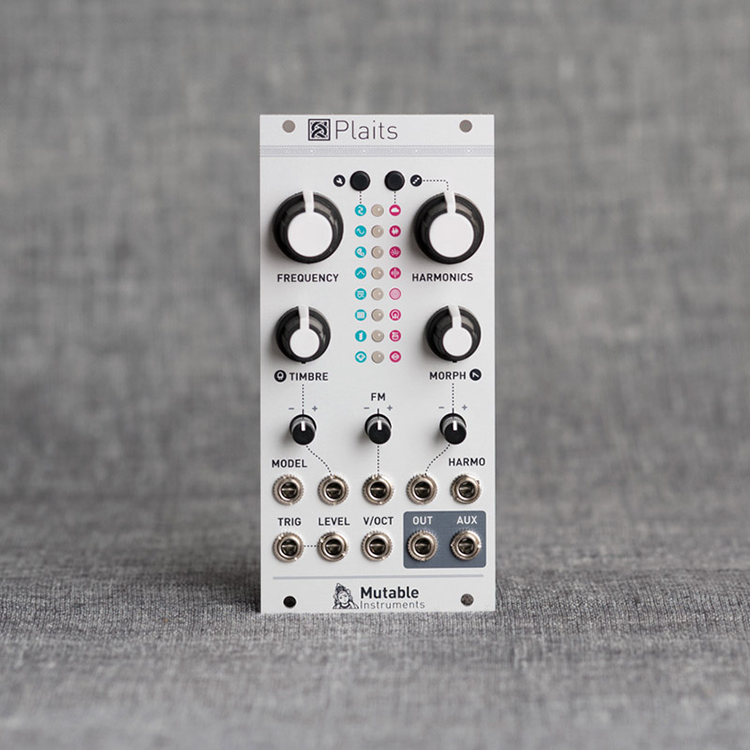
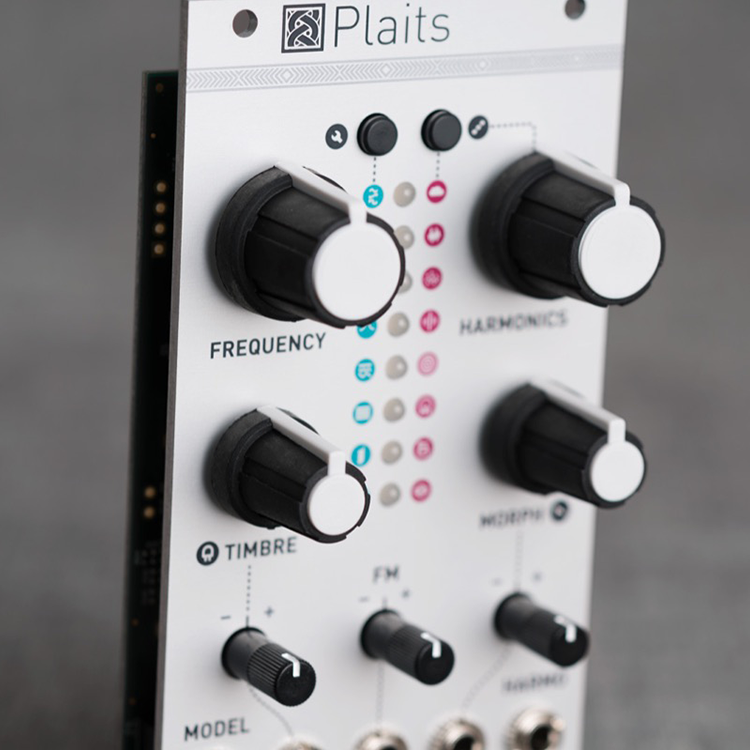
REBOOTING A CLASSIC
Plaits is the spiritual successor of Mutable Instruments’ best-selling voltage-controlled sound source, Braids. Not just a mkII version: its hardware and software have been redesigned from scratch.
Just like its predecessor, it offers direct access to a large palette of easily tweakable raw sonic material, covering the whole gamut of synthesis techniques.
SIMPLICITY FIRST
Gone are the screen, menu system, hidden settings, and the long list of somewhat redundant synthesis models.
Thanks to additional CV inputs, and to the use of three timbre-shaping parameters per model, Plaits is straightforward to use, and much closer to the ideal of one synthesis technique = one model. What were fragmented islands of sound in Braids are now part of a continuum of sounds.
READY FOR PERCUSSION
Patch a trigger generator or sequencer into Plaits’ trigger input and instantly use the module as a percussive source thanks to its built-in virtual low-pass gate (LPG).
An internal D (decay) envelope generator is normalled to all unpatched CV inputs. Just turn the corresponding attenuverter to add pitch, timbre or morphing modulation. And if plucks and snappy hits are not your thing, patch your own envelope or CV source into the LPG CV input.
16 deep synthesis models
8 synthesis models for pitched sounds
- Two detuned virtual analog oscillators with continuously variable waveforms.
- Variable slope triangle oscillator processed by a waveshaper and wavefolder.
- 2-operator FM with continuously variable feedback path.
- Two independently controllable formants modulated by a variable shape window (VOSIM, Pulsar, Grainlet, Casio CZ-style resonant filter…).
- 24-harmonic additive oscillator.
- Wavetable oscillator with four banks of 8x8 waves, with or without interpolation.
- Chord generator, with divide down string/organ emulation or wavetables.
- A collection of speech synthesis algorithms (formant filter, SAM, LPC), with phoneme control and formant shifting. Several banks of phonemes or segments of words are available.
8 synthesis models for noise and percussions
- Granular sawtooth or sine oscillator, with variable grain density, duration and frequency randomization.
- Clocked noise processed by a variable shape resonant filter.
- 8 layers of dust/particle noise processed by resonators or all-pass filters.
- Extended Karplus-Strong (aka Rings’ red mode), excited by bursts of white noise or dust noise.
- Modal resonator (aka Rings’ green mode), excited by a mallet or dust noise.
- Analog kick drum emulation (two flavors).
- Analog snare drum emulation (two flavors).
- Analog high-hat emulation (two flavors).
Dual output
- The AUX output carries a variant, sidekick or by-product of the main signal.
- Patch both OUT and AUX to Warps for weird hybridization experiments!
Internal or external modulations
- Dedicated CV input for synthesis model selection. No need to activate a mysterious META mode!
- An internal decay envelope is normalled to the TIMBRE, FM and MORPH CV inputs: the amount of internal modulation is directly adjusted with the attenuverters.
Internal low-pass gate (LPG)
- Dedicated LEVEL CV input controlling the amplitude and brightness of the output signal.
- The internal LPG can also be directly plucked by the trigger input.
- Two parameters of the LPG can be adjusted: amount of low-pass filtering (VCFA to VCA), and response time of the virtual vactrol.
Specifications
- All inputs: 100k impedance, DC to 2kHz.
- FM, MORPH, TIMBRE input range: +/- 8V.
- HARMO and MODEL input range: +/- 5V.
- LEVEL and TRIG input range: 0 to +8V.
- V/O input range: -3 to +7V.
- 16-bit CV capture.
- Audio output: 48kHz, 16-bit, DC-coupled.
- Internal processing: 32-bit floating point.
Plaits vs Braids?
Plaits shares no hardware or software with Braids!
- Floating-point DSP code written from scratch or inherited from Elements, Warps and Rings.
- Band-limited synthesis used almost everywhere, producing aliasing-free results at the base sample rate of 48kHz (Braids ran at 96kHz and used naive oversampling).
- High-quality Sigma-Delta ADC for CV acquisition, approaching a resolution of 16-bit (12-bit for Braids).
- ADC reads are interpolated in software to eliminate zipper noise.
- DC-coupled audio output, extending the range of the module to very low frequencies (Braids could not reach LFO ranges).
- Lean hardware design: less HP, mA and €.


Reviews:
Purchase FAQ
Q1. What is the inspection period?
According to the Consumer Protection Act, online purchases come with a 7-day inspection period starting from the delivery date. Please note that the "inspection period is not a trial period." The purpose is for you to inspect and review the product, not to use it. If you are unsatisfied after inspection, please do not open or use the product and follow the return procedures immediately. Returned products must be in complete packaging with all accessories, gifts, and original packaging intact. Any missing, damaged, or incomplete items may affect your return rights and restoration costs may be deducted.
Q2. How do I process a return or exchange?
If you wish to return a product, please ensure it is in complete, new condition with the original packaging undamaged. This includes the product itself, accessories, warranty card, original packaging, and all accompanying documents. If the product is damaged due to reasons attributable to you, we may not be able to process the return, or repair costs may be deducted from the refund. However, products with manufacturing defects are exempt and qualify for unconditional return or exchange.
Please contact us by phone or email within the inspection period, providing the reason for the return/exchange, current product condition, phone number, and pickup address. We will arrange the return within 3-5 business days.
Q3. How will I receive my refund, and how long does it take?
Refund methods and timelines vary by payment method:
Credit Card: After we receive the returned product, the refund will be credited to your credit card account within approximately 5-7 business days. Depending on your billing cycle, the refund may appear on your current or next statement. Please confirm with your credit card issuing bank.
Bank Transfer: Please contact service [at] digilog.tw with your complete bank details (bank name, branch name, bank code, account holder name, account number). We will arrange courier pickup of the returned product and transfer the refund to your designated account within 5-7 business days.
Q4. Do I need to pay for shipping when sending products for repair?
Round-trip shipping costs for product repairs are the customer's responsibility.
You may be interested in:
MIDI to CV
Expert Sleepers FH-2
Expert Sleepers FH-2
Price
NT
10,900
Price
NT
10,900
-13%
Utility
Noise Engineering Muta Jovis
Noise Engineering Muta Jovis
NT 4,790
Price
NT
4,190
NT 4,790
Price
NT
4,190
-8%
Drum Module
Erica Synths Pico Drum 2
Erica Synths Pico Drum 2
NT 5,300
Price
NT
4,900
NT 5,300
Price
NT
4,900
-10%
Filter
INSTRUŌ dåpf INSTRUO 模組化合成器
INSTRUŌ dåpf INSTRUO 模組化合成器
NT 9,200
Price
NT
8,250
NT 9,200
Price
NT
8,250

-7%
Mixer
XAOC Devices OSTRAWA
XAOC Devices OSTRAWA
NT 19,900
Price
NT
18,500
NT 19,900
Price
NT
18,500

Utility
4ms MetaModule Audio Expander MetaAIO
4ms MetaModule Audio Expander MetaAIO
Price
NT
6,250
Price
NT
6,250
 What's New
 Brands
 Rental
目前尚無評論