NT$ 22,300
Home » Modular Synthesizer » Effects » Audio Damage ADM23 EOS
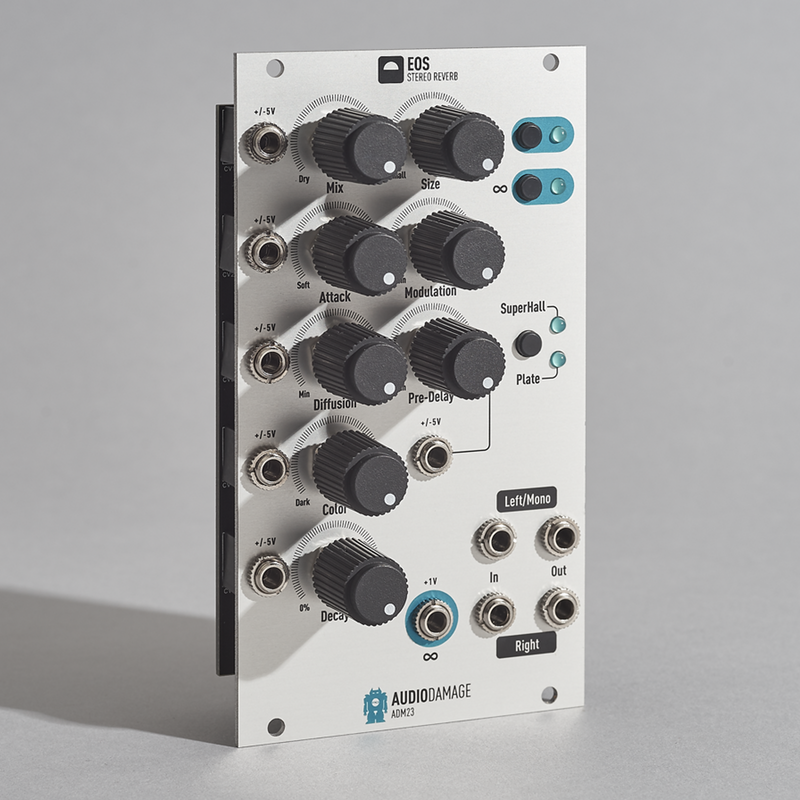
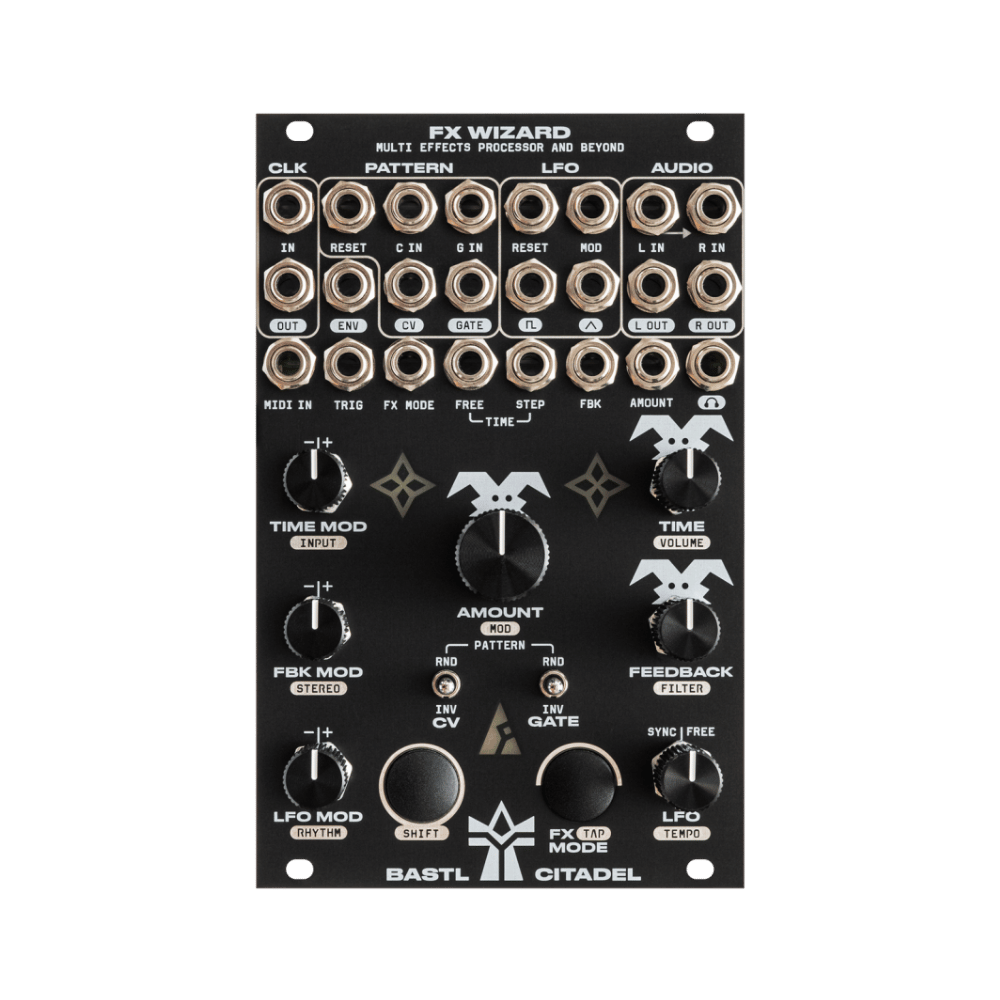
A long-time favorite of our plug-in users, the Eos reverb is now available in Eurorack! This module is code-identical to the Eos plug-in, with the Superhall and Plate algorithms made famous in the original. With an easy-to-understand interface, and a 48k/24 bit true stereo audio path, Eos is a top-of-the-line commercial studio quality reverb for your Eurorack system.
The Plate algorithm in Eos is an unique implementation of the traditional digital plate, rich and full, perfect for drum and vocal simulation. The Superhall algorithm is designed to emulate the incredibly long, chorusy reverb tails heard on Harold Budd/Brian Eno records, and is what makes Eos amazing on synth sounds.
Controls
Mix - This controls the wet/dry mix. At full anti-clockwise, only the dry signal appears at the outputs. At full clockwise, only the wet signal appears. An equal-power crossfade mixes between the two.
Attack - This controls the presence of the initial early reflections. At full anti-clockwise, the reflections are more or less equal. At full clockwise, an exponential decay occurs, with the initial reflection being much louder. This results in a more percussive and rich reverb tail.
Diffusion - This controls the amount of diffusion applied to the early reflections. At full anti-clockwise, no diffusion is applied, and the early reflections are very clear. At full clockwise, the early reflections are entirely "smeared." Essentially, it controls the smoothness of the reverb.
Color - This is an omnibus control for the several EQ parameters in the algorithm. At full anti-clockwise, the reverb tail will be very dark, and have no high end, and at full clockwise, it will be very bright, and have no low end. In the middle, no EQ is applied.
Decay - This is the decay time of the reverb tail (called "RT60" in the 'verb business.) At full anti-clockwise, you will hear almost no tail, and at full clockwise, the RT60 (or time to -60dB) will be over a minute long in Superhall mode, and about 45 seconds in Plate mode with Size at maximum.
Size - This controls the physical size of the simulated hall or plate. Together with the Decay control, this describes the personality of the reverb. Note that this control has no modulation input, and you will experience some noise bursts if you adjust it while there is audio circulating in the reverb tank. This is unavoidable, as the control changes the times of over a dozen delays.
Modulation - This controls the amount of modulation applied to the delays in the reverb tank. In effect, it is a chorus control. It is a subtle control, and only really apparent with a long decay. At full anti-clockwise, the reverb tail will be icy and clean, while at full clockwise, it will be rich and full.
Pre-Delay - This controls the amount of time between when the original signal is heard, and when the signal enters the reverb tank. The response is somewhat different depending on the mode; in Plate mode, the first early reflection will occur at the set time, and so on. In Superhall mode, this effectively controls the "spread" of the early reflections.
Lock & Infinite - These two buttons control the Infinite mode (or "freeze effect.") When Lock is illuminated, Infinite is a toggle switch, and when Lock is not illuminated, Infinite is a momentary switch. The Infinite jack responds to a +1V trigger when locked (which turns Infinite on and off) and a +1V gate in unlocked, where the Infinite will be activated for the duration of the gate. The effect itself basically gives the reverb an infinite decay. Note that the inputs are still active, so further input after the Infinite mode is activated will accumulate.
Algorithm - This button switches between Superhall and Plate mode.
Panel Memory - The Algorithm and Lock buttons remember their state. Once you make a selection, the value is written to EEPROM memory after 30 seconds. If the module loses power before 30 seconds, it will not remember the selection, and will revert to the previous saved state.
I/O - Eos has a 48kHz sample rate at 24 bits, with 32-bit floating point internal operation. The I/O is true stereo, and changes internal routing based on what is plugged in. For mono use, just use the left side I/O. For mono to stereo (the normal configuration as a send effect), use the left input and both outputs. The internal DSP will route itself accordingly.
Mechanical Info - Eos has a 125ma current draw on the +12V rail, approximately 10ma on the -12V rail. It has an on-board regulator, and does not require +5V. It is 14HP in width, and has a depth of 25mm. It has a USB port on the backplane for firmware updates.


Reviews:
Purchase FAQ
Q1. What is the inspection period?
According to the Consumer Protection Act, online purchases come with a 7-day inspection period starting from the delivery date. Please note that the "inspection period is not a trial period." The purpose is for you to inspect and review the product, not to use it. If you are unsatisfied after inspection, please do not open or use the product and follow the return procedures immediately. Returned products must be in complete packaging with all accessories, gifts, and original packaging intact. Any missing, damaged, or incomplete items may affect your return rights and restoration costs may be deducted.
Q2. How do I process a return or exchange?
If you wish to return a product, please ensure it is in complete, new condition with the original packaging undamaged. This includes the product itself, accessories, warranty card, original packaging, and all accompanying documents. If the product is damaged due to reasons attributable to you, we may not be able to process the return, or repair costs may be deducted from the refund. However, products with manufacturing defects are exempt and qualify for unconditional return or exchange.
Please contact us by phone or email within the inspection period, providing the reason for the return/exchange, current product condition, phone number, and pickup address. We will arrange the return within 3-5 business days.
Q3. How will I receive my refund, and how long does it take?
Refund methods and timelines vary by payment method:
Credit Card: After we receive the returned product, the refund will be credited to your credit card account within approximately 5-7 business days. Depending on your billing cycle, the refund may appear on your current or next statement. Please confirm with your credit card issuing bank.
Bank Transfer: Please contact service [at] digilog.tw with your complete bank details (bank name, branch name, bank code, account holder name, account number). We will arrange courier pickup of the returned product and transfer the refund to your designated account within 5-7 business days.
Q4. Do I need to pay for shipping when sending products for repair?
Round-trip shipping costs for product repairs are the customer's responsibility.
You may be interested in:

VCO
Intellijel Dixie²+ VCO/LFO
Intellijel Dixie²+ VCO/LFO
Price
NT
8,890
Price
NT
8,890
-7%
VCA
4ms VCA Matrix
4ms VCA Matrix
NT 13,800
Price
NT
12,900
NT 13,800
Price
NT
12,900
Sequencer
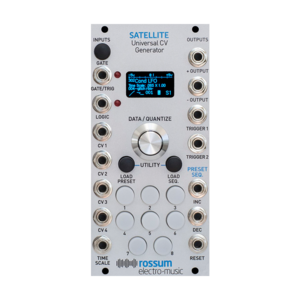
Rossum Electro-Music Satellite
Rossum Electro-Music Satellite
Price
NT
13,900
Price
NT
13,900
Filter
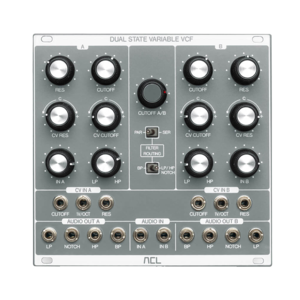
ACL Dual State Variable VCF
ACL Dual State Variable VCF
Price
NT
20,900
Price
NT
20,900

-7%
VCO
2hp Swarm Hyper Oscillator 模組化合成器
2hp Swarm Hyper Oscillator 模組化合成器
NT 5,890
Price
NT
5,490
NT 5,890
Price
NT
5,490
 What's New
 Brands
 Rental
目前尚無評論