NT$ 21,500
Home » Modular Synthesizer » Drum Module » Audio Damage ADM14 BOOMTSCHAK
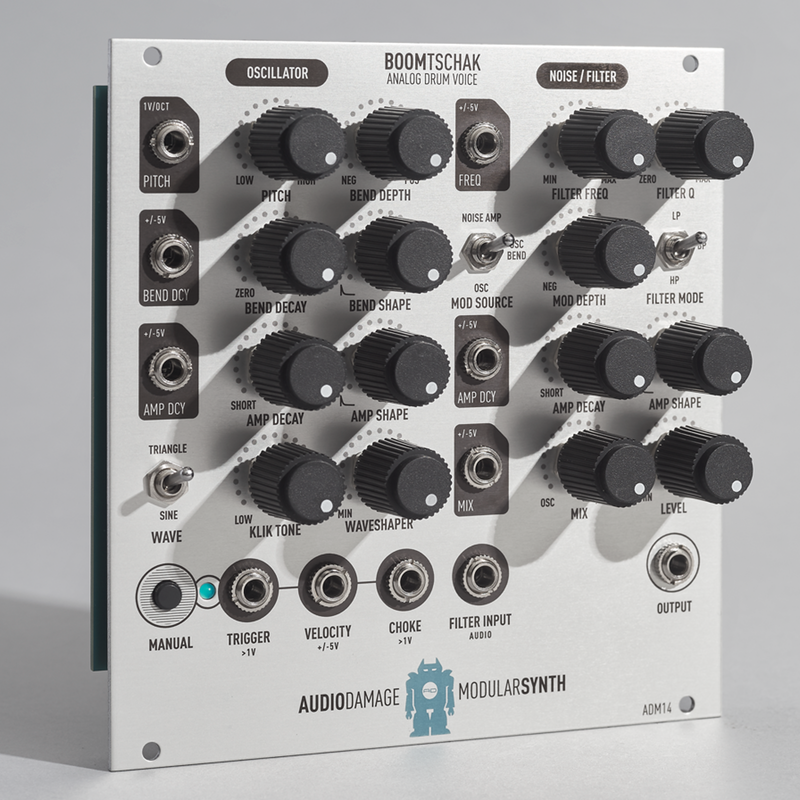
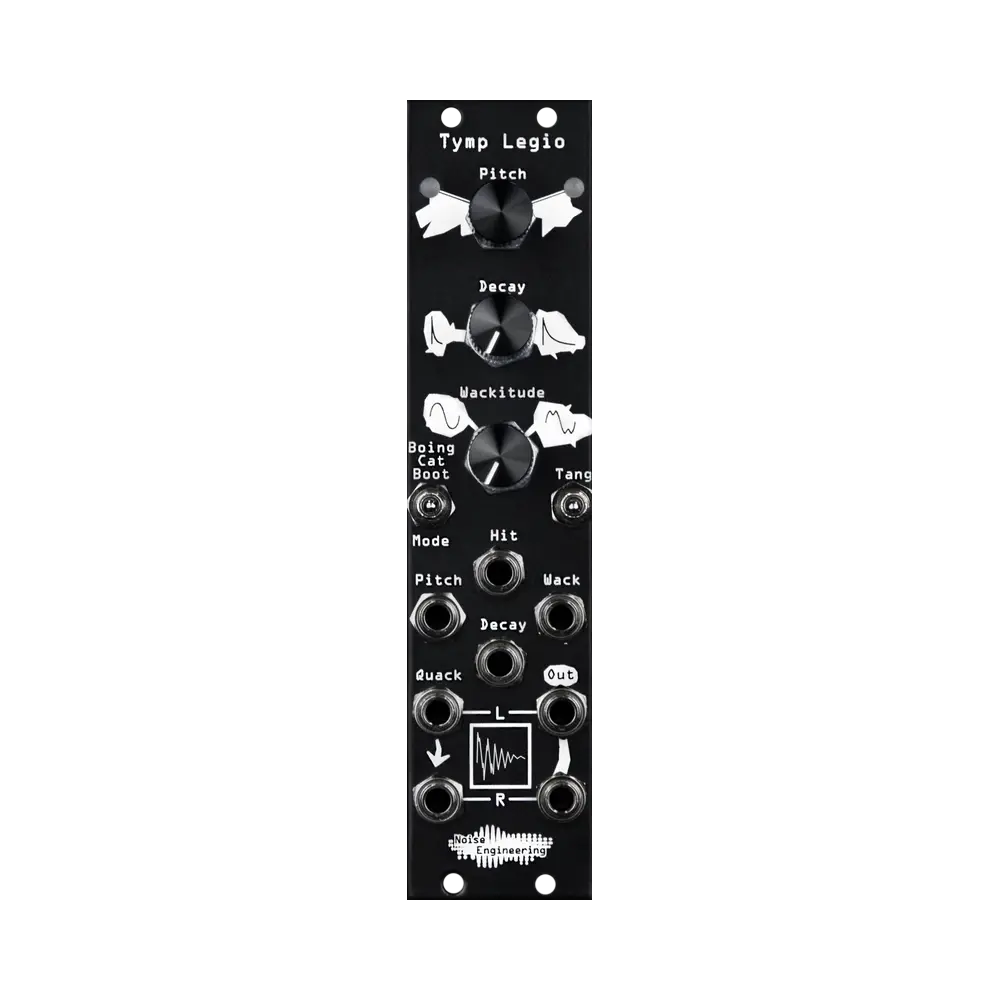
Our goal with this product was to make a no-compromises, versatile drum voice with a 100% analog signal path, and that made us happy. The first part was relatively simple. The "happy" part took a while. But after over a year of R&D and many, many iterations, we're pleased to present ADM14 Boomtschak, a drum voice that we're proud to call ours.
The left side of the unit comprises a triangle core oscillator, a VCA, two envelopes, and a waveshaper, and the right side is a noise source, multi-mode resonant filter, VCA, and one envelope. With a logical layout and versatile voice topology, Boomtschak is capable of face-melting kick drums and snares, and more strange percussion and sound FX than you can shake a (drum) stick at. The oscillator bottoms out at 5 Hz (!!!), and can track 1V/Oct over nearly seven octaves, so you can also use Boomtschak as a synth voice, for paint-peeling sub bass or a mallet-style melodic source higher up.
The trigger and choke allow full control over the enveloping, while a velocity CV input allows dynamic control. These, plus control voltage inputs over pertinent values make Boomtschak incredibly expressive. All in all, it is one of the most versatile and potent drum voices available for the Eurorack platform.
Features
Pitch – sets the frequency of the VCO
Bend Depth – controls how much the pitch-bend envelope generator changes the frequency of the VCO. This is a bidirectional control; at its center position, the EG has no effect on the VCO.
Bend Decay – sets the decay time of the pitch-bend EG.
Bend Shape – varies the shape of the pitch-bend EG from a sharp exponential curve to a linear ramp.
Amp Decay – sets the decay time of the envelope generator which controls the VCA for the VCO, and hence how long the VCO tone is heard.
Amp Shape - varies the shape of the VCO amplitude EG from a sharp exponential curve to a linear ramp.
Wave Switch – switches the VCO output between a triangle wave and a quasi sine wave.
Klik Tone – changes the brightness of a short click added to the beginning of the sound.
Waveshaper – controls a simple wave-folder which changes the shape of the VCO’s signal.
Filter Freq – sets the frequency of the multi-mode filter for the noise source.
Filter Q – sets the resonance of the filter.
Mod Source Switch – choose the source of modulation for the filter frequency. There are three options: the amplitude envelope generator for the noise source, the pitch bend oscillator for the VCO, and the VCO’s signal.
Mod Depth – controls how much the modulation signal selected with the MOD SOURCE switch changes the filter frequency. This is a bidirectional control; at its center position, the filter frequency will not be changed by the modulation signal.
Filter Mode Switch – chooses one of three filter response modes: low pass, band pass, or high pass.
Amp Decay – sets the decay time of the envelope generator which controls the VCA for the noise source, and hence how long the noise is heard.
Amp Shape - varies the shape of the noise amplitude EG from a sharp exponential curve to a linear ramp.
Mix – varies the relative loudness of the VCO and the noise source. At its center position, the noise source and VCO have roughly equal loudness. Rotate the knob counter-clockwise to hear more of the VCO, rotate it clockwise to hear more noise.
Level – sets the overall output level of the module.
Manual Button – press this to trigger the module manually. Use it while setting BoomTschak’s knobs or for live improvisation.
Trigger Input – Apply a positive-going rectangular wave to this jack to trigger the module. A +5V signal is best but the module will trigger at lower voltages.
Velocity – A control-voltage input for varying the loudness of the module. Positive voltages increase the loudness; negative voltages decrease it.
Choke – A positive-going rectangular pulse applied to this input will cut off (choke) the output of the module.
Filter Input – Plugging a signal into this jack will bypass the module’s noise source, passing the signal through the filter.
CV Inputs – There are five control-voltage jacks associated with some of the knobs. Applying a positive voltage to these jacks has the same effect as turning the associated knob clockwise; applying a negative voltage has the opposite effect.
Mechanicals - Boomtschak is 24HP wide, and has a depth of 16mm; it will fit in any skiff. It ships with a 16-conductor keyed power cable and four nickel-plated M3x6 screws.
Pitch – sets the frequency of the VCO
Bend Depth – controls how much the pitch-bend envelope generator changes the frequency of the VCO. This is a bidirectional control; at its center position, the EG has no effect on the VCO.
Bend Decay – sets the decay time of the pitch-bend EG.
Bend Shape – varies the shape of the pitch-bend EG from a sharp exponential curve to a linear ramp.
Amp Decay – sets the decay time of the envelope generator which controls the VCA for the VCO, and hence how long the VCO tone is heard.
Amp Shape - varies the shape of the VCO amplitude EG from a sharp exponential curve to a linear ramp.
Wave Switch – switches the VCO output between a triangle wave and a quasi sine wave.
Klik Tone – changes the brightness of a short click added to the beginning of the sound.
Waveshaper – controls a simple wave-folder which changes the shape of the VCO’s signal.
Filter Freq – sets the frequency of the multi-mode filter for the noise source.
Filter Q – sets the resonance of the filter.
Mod Source Switch – choose the source of modulation for the filter frequency. There are three options: the amplitude envelope generator for the noise source, the pitch bend oscillator for the VCO, and the VCO’s signal.
Mod Depth – controls how much the modulation signal selected with the MOD SOURCE switch changes the filter frequency. This is a bidirectional control; at its center position, the filter frequency will not be changed by the modulation signal.
Filter Mode Switch – chooses one of three filter response modes: low pass, band pass, or high pass.
Amp Decay – sets the decay time of the envelope generator which controls the VCA for the noise source, and hence how long the noise is heard.
Amp Shape - varies the shape of the noise amplitude EG from a sharp exponential curve to a linear ramp.
Mix – varies the relative loudness of the VCO and the noise source. At its center position, the noise source and VCO have roughly equal loudness. Rotate the knob counter-clockwise to hear more of the VCO, rotate it clockwise to hear more noise.
Level – sets the overall output level of the module.
Manual Button – press this to trigger the module manually. Use it while setting BoomTschak’s knobs or for live improvisation.
Trigger Input – Apply a positive-going rectangular wave to this jack to trigger the module. A +5V signal is best but the module will trigger at lower voltages.
Velocity – A control-voltage input for varying the loudness of the module. Positive voltages increase the loudness; negative voltages decrease it.
Choke – A positive-going rectangular pulse applied to this input will cut off (choke) the output of the module.
Filter Input – Plugging a signal into this jack will bypass the module’s noise source, passing the signal through the filter.
CV Inputs – There are five control-voltage jacks associated with some of the knobs. Applying a positive voltage to these jacks has the same effect as turning the associated knob clockwise; applying a negative voltage has the opposite effect.
Mechanicals - Boomtschak is 24HP wide, and has a depth of 16mm; it will fit in any skiff. It ships with a 16-conductor keyed power cable and four nickel-plated M3x6 screws.


Reviews:
Purchase FAQ
Q1. What is the inspection period?
According to the Consumer Protection Act, online purchases come with a 7-day inspection period starting from the delivery date. Please note that the "inspection period is not a trial period." The purpose is for you to inspect and review the product, not to use it. If you are unsatisfied after inspection, please do not open or use the product and follow the return procedures immediately. Returned products must be in complete packaging with all accessories, gifts, and original packaging intact. Any missing, damaged, or incomplete items may affect your return rights and restoration costs may be deducted.
Q2. How do I process a return or exchange?
If you wish to return a product, please ensure it is in complete, new condition with the original packaging undamaged. This includes the product itself, accessories, warranty card, original packaging, and all accompanying documents. If the product is damaged due to reasons attributable to you, we may not be able to process the return, or repair costs may be deducted from the refund. However, products with manufacturing defects are exempt and qualify for unconditional return or exchange.
Please contact us by phone or email within the inspection period, providing the reason for the return/exchange, current product condition, phone number, and pickup address. We will arrange the return within 3-5 business days.
Q3. How will I receive my refund, and how long does it take?
Refund methods and timelines vary by payment method:
Credit Card: After we receive the returned product, the refund will be credited to your credit card account within approximately 5-7 business days. Depending on your billing cycle, the refund may appear on your current or next statement. Please confirm with your credit card issuing bank.
Bank Transfer: Please contact service [at] digilog.tw with your complete bank details (bank name, branch name, bank code, account holder name, account number). We will arrange courier pickup of the returned product and transfer the refund to your designated account within 5-7 business days.
Q4. Do I need to pay for shipping when sending products for repair?
Round-trip shipping costs for product repairs are the customer's responsibility.
You may be interested in:

-4%

-3%
-3%

 What's New
 Brands
 Rental
目前尚無評論