NT$ 10,500
Home » Modular Synthesizer » Utility » WMD Compressor
Sidechainable, analog dynamic processing
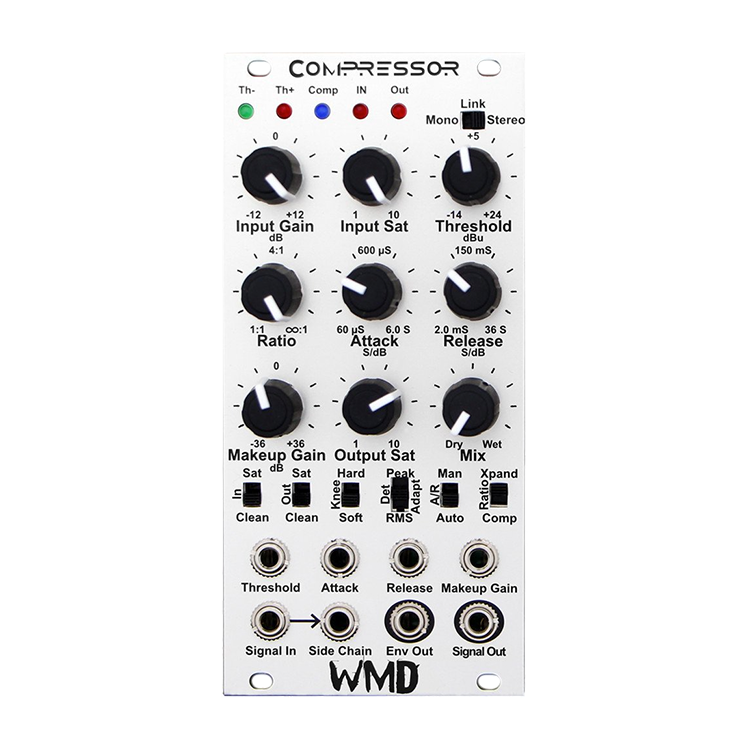
Dynamics processing is not something typically considered in modular synthesis, especially subtractive patches. With many synthesists doing fully modular feedback patches, percussion and outboard processing with their modulars, compression now has a place in a eurorack.
The WMD Compressor is designed to serve all of your normal dynamics processing needs, but it pushes boundaries further. It can subtly calm resonance peaks, or it can add dynamic character to a bass patch. It can also completely crush and distort a patch into a pumping breathing monster.
The WMD Compressor is designed around the THAT 4301 core, a high end dynamics processor. It has been adapted for modular levels, but will work with +4 line level signals as well. It is designed to be transparent, using only ultra low noise opamps, but it also has variable input and output saturation to add some character and distortion.
- THAT 4301 Forward Compressor
- Ultra Low Noise Opamps
- DC Coupled Throughout
- Input and Output Variable Saturation
- +-12dB of Input Gain
- Manual/Auto Attack and Release
- Hard or Soft Knee
- RMS/Peak/Adaptive Level Detection
- Expander Mode
- Infinite Ratio for Limiting
- CV Control
- Wet/Dry for Parallel Compression
- Side Chain Input
- Envelope Output
- LEDs for Threshold & Compression
- Stereo Operation by Linking
- 12 HP wide.
- +52mA, -40mA Current Draw
Theory of Operation
The WMD Compressor is a feed-forward design where the input signal is analyzed to determine how much compression is necessary. This architecture is powerful and fast and offers plenty of control over the compression control signal.
The signal path is short, consisting of an input gain stage, the compressor VCA stage and then the final output mix stage. The input stage uses a TLE2027 ultra low noise and low offset opamp. The VCA and output mix use OPA1641 low noise high-headroom opamps. The maximum output swing is close to the supply rails at 22Vpp.
The Manual Attack/Release circuitry is based on principles designed into the Multimode Envelope. It is incredibly fast and can range to a near stop. This allows you to use the envelope as an effect, and use the CV to halt compression if desired. Too fast of both Attack and Release times will introduce distortion as the follower attempts to follow the signal itself rather than the envelope of the signal.
The Side Chain lets you use another signal to control compression of the input. This lets you duck a bass sound for the kick, or duck a mix for voiceover work, or distort a lead when something else is happening. The Side Chain is very useful for adding dynamics to a patch quickly and easily. It also lets you use the Compressor to work in feedback mode, where the Compressor controls the input to a filter, and the output of that filter is run through the side chain; then when resonance starts to distort the signal, the input is dropped down to compensate. This allows for very smooth resonant patches.
The Input and Output Saturation circuits are voiced differently from each other. The input side saturation works with the input gain control to give a very soft clipping. Lots of 2nd order harmonics to warm your signal here. Input saturation will be present on the Dry side of the Mix control as well as be passed through to the follower and the compression core. Output saturation is active on the Compressor's VCA circuit. It can clip much harder than the input side. Output saturation is great for distorting the initial transient from a slower attack, giving the initial hit more harmonics and a punchy timbre.
The Controls
Input Gain - Sets the input level on the Signal In jack. Range is +-12dB. 12 o’clock is unity gain. This level is normaled to the Side Chain input. Input level is indicated on the red In LED.
Input Saturation - This knob and control switch determine the amount of input side saturation. The circuit is a soft clipper that begins to clip at +-4 volt peaks. Switch must be up for knob to be enabled.
Threshold - This sets the input level where compression starts to happen. Its range from -14dB to +24dB covers the modular range. There is a CV input for this control that is added to the knob value. Th+ and Th- LEDs indicate whether the input signal is above or below the compression threshold.
Knee Switch - This switch determines the threshold break point behavior. Hard knee will start compression at the specified ratio immediately at the break point. Soft knee starts compression slowly over the range of 3dB before the break point.
Ratio - Controls the amount of compression as a function of input level to output level. So, for every dB in level increase past the threshold, you get X level increase in the output. 4:1 ratio means 4dB input to get a 1dB change in output. ∞:1 is a limiter where the input signal is limited to the threshold level.
Detector Mode Switch - This three position switch selects between RMS, Adaptive and Peak level detection modes.
- RMS - Ignores fast transients, slower and smoother. Good for un-compressed attack transients. More vintage sounding compression.
- Adaptive - Smooth like RMS, but detects fast transients. Good for many types of material. Modern sounding compression.
- Peak - Very fast, follows the signal closely. Use with manual A/R with slower release for good peak limiting.
A/R Switch - This switch determines whether the manual Attack and Release knobs are activated, or if the Level Detector automatically controls attack and release times. Switch must be in Manual mode for Attack and Release knobs and CV to be enabled.
Attack - This knob sets the amount of time taken for the onset of compression. Rotate clockwise for a slower attack. Attack may be affected by the CV input. Attack is measured in Seconds / dB.
Release - Controls the amount of time to open the compressor after the input signal goes back below the current level of compression. Rotate clockwise for longer release. Release may be affected by the CV input. Release is measured in Seconds / dB.
Ratio Mode - This switch controls whether the compressor reduces output level as the threshold is crossed (Comp), or increases level by the Ratio as the threshold is crossed (Xpand). Beware that flipping to Xpand will greatly increase the volume at the output. Reduce Makeup Gain before engaging this switch.
Comp LED - This blue LED shows the compression level to give rough feedback as to how much compression is taking place.
Makeup Gain - This controls the amount of gain at the output stage. Range is -36dB to +36dB. Use higher settings to bring the level back up after high compression. If using Xpand mode, set this lower than 0dB to avoid high output levels. There is a CV input to further control the amount of Makeup Gain.
Output Saturation - This switch must be enabled for the knob to have an effect. Moderately Hard LED saturation begins at +-6 volt peaks.
Mix - This knob mixes the dry input signal with the wet output signal, allowing for simple parallel compression. Also use it as a way to compare input to output easily. This is the final output to the Signal Output jack. Its level is indicated on the red Out LED.
Side Chain - This input drives the level detector of the compressor. When nothing is plugged in, the Input signal is normaled through to the detector. This allows you to use the compressor as a ducker or expander with other signals.
Envelope Out - This output jack produces the Compressor’s control signal for use in other places in your modular.
Stereo Link - If you have two WMD compressors, you can link them together with an 1/8” cable on the back. Flipping each Compressor’s Link switch to Stereo will connect the two detectors together for true stereo bus compression. Knobs must be set the same for both channels to truly behave the same, as only the detector information is shared.
Specs:
- Power: +12V = 52mA; -12V = 40mA
- Size: 12 HP.
- Depth: 25mm.
- Every WMD product is warranted for 12 months after purchase, but please contact us if you ever have problems. We will take care of you.


Reviews:
Purchase FAQ
Q1. What is the inspection period?
According to the Consumer Protection Act, online purchases come with a 7-day inspection period starting from the delivery date. Please note that the "inspection period is not a trial period." The purpose is for you to inspect and review the product, not to use it. If you are unsatisfied after inspection, please do not open or use the product and follow the return procedures immediately. Returned products must be in complete packaging with all accessories, gifts, and original packaging intact. Any missing, damaged, or incomplete items may affect your return rights and restoration costs may be deducted.
Q2. How do I process a return or exchange?
If you wish to return a product, please ensure it is in complete, new condition with the original packaging undamaged. This includes the product itself, accessories, warranty card, original packaging, and all accompanying documents. If the product is damaged due to reasons attributable to you, we may not be able to process the return, or repair costs may be deducted from the refund. However, products with manufacturing defects are exempt and qualify for unconditional return or exchange.
Please contact us by phone or email within the inspection period, providing the reason for the return/exchange, current product condition, phone number, and pickup address. We will arrange the return within 3-5 business days.
Q3. How will I receive my refund, and how long does it take?
Refund methods and timelines vary by payment method:
Credit Card: After we receive the returned product, the refund will be credited to your credit card account within approximately 5-7 business days. Depending on your billing cycle, the refund may appear on your current or next statement. Please confirm with your credit card issuing bank.
Bank Transfer: Please contact service [at] digilog.tw with your complete bank details (bank name, branch name, bank code, account holder name, account number). We will arrange courier pickup of the returned product and transfer the refund to your designated account within 5-7 business days.
Q4. Do I need to pay for shipping when sending products for repair?
Round-trip shipping costs for product repairs are the customer's responsibility.
You may be interested in:

Envelope
2hp EG Envelope Generator
2hp EG Envelope Generator
Price
NT
3,990
Price
NT
3,990
Effect (Delay)
Erica Synths Pico BBD
Erica Synths Pico BBD
Price
NT
4,600
Price
NT
4,600

-10%
Utility
4ms MetaModule (META)
4ms MetaModule (META)
NT 23,900
Price
NT
21,500
NT 23,900
Price
NT
21,500

Mixer
BASTL Instruments Waver
BASTL Instruments Waver
Price
NT
10,000
Price
NT
10,000

Utility
Tiptop Audio Buchla 242t Programmab...
Tiptop Audio Buchla 242t Programmab...
Price
NT
7,800
Price
NT
7,800
 What's New
 Brands
 Rental
目前尚無評論