NT$ 10,800
Home » Modular Synthesizer » Modulation » Mutable Instruments Stages
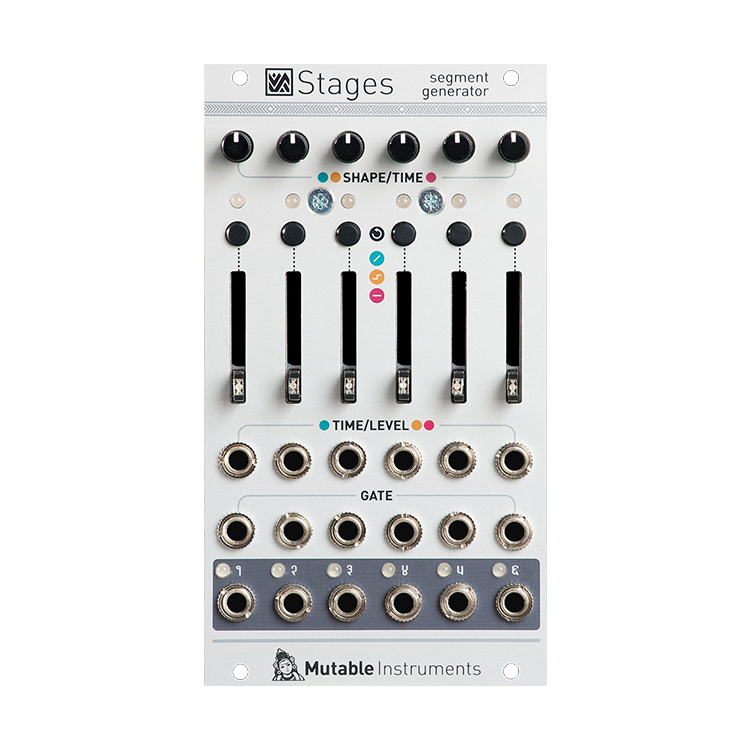
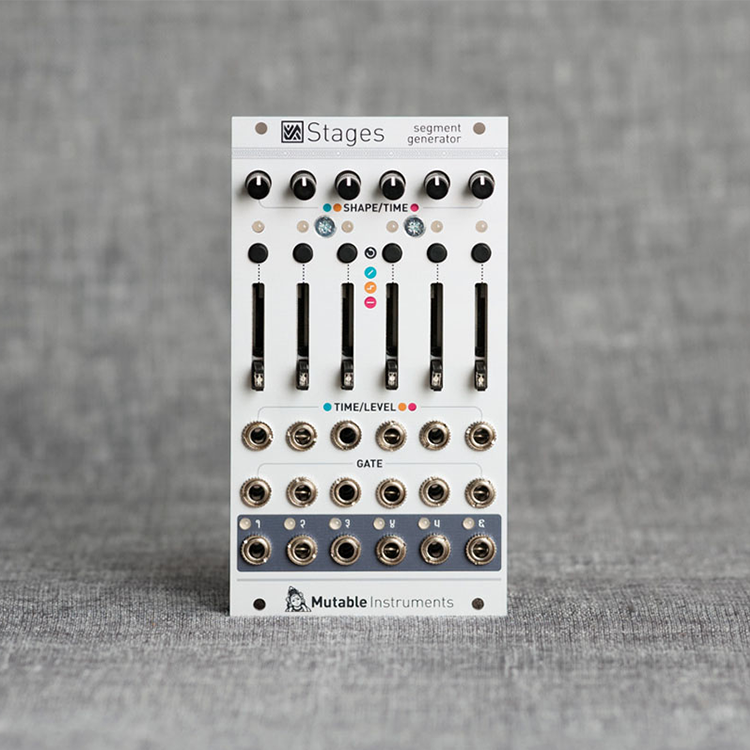
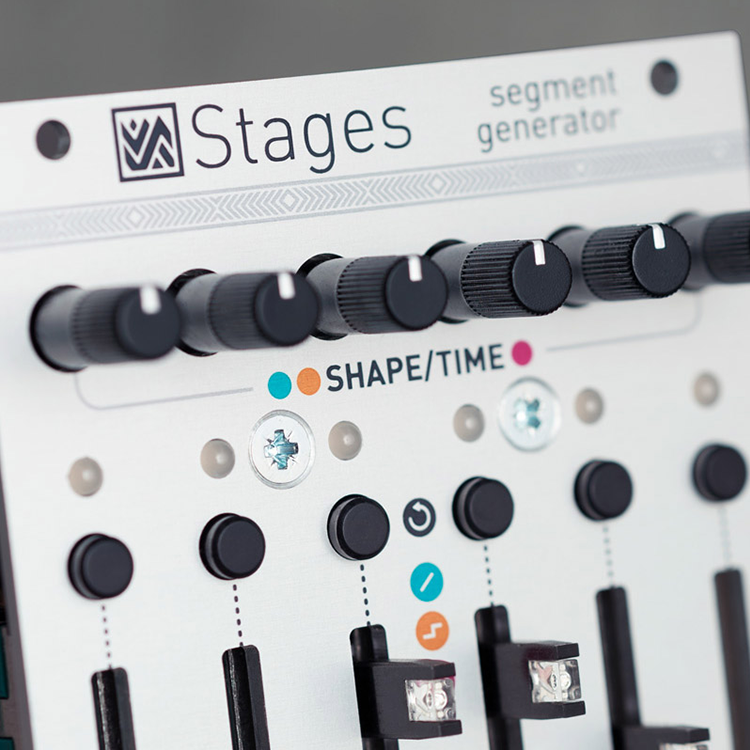
THE MODULATION CONSTRUCTION SET
ASR envelope, complex 6-stage envelope, LFO, 4-step sequence or switched LFO: Stages can be any kind of modulation.
Not because all these behaviors have been pre-programmed in the module, but because it allows you to describe your own modulations in terms of basic operations: ramp from one voltage to another, hold a voltage at a set level, wait for a trigger and slew. With or without looping.
Whether you need one complex envelope, or several simpler modulations, Stages reconfigures itself according to which of its gate inputs are patched. There is always a role for it in your patch.
THAT’S IT
Really, there isn’t more to the story.
Self-generating chiptunes? Very weird LFO shapes? Random gate delay? Stages probably does strange and wonderful things when patched in a certain way.
Flexible input/output layout
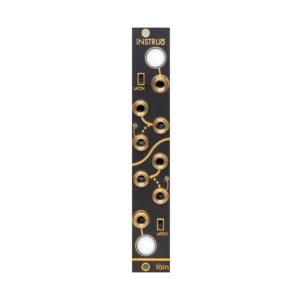
The module detects the presence of jacks on its gate inputs to group its segments: whether it is configured as a complex 6-stage envelope, or 6 individual envelopes, or 3+3, 2+4… depends simply on how you patch it. Dummy patch cables might come handy!
When used as a multi-segment envelope, a segment activation signal is produced on all secondary outputs - for example to trigger an external event when an ADSR envelope enters its decay, sustain or release stages.
In case more than 6 segments are required, up to six modules can be chained together thanks to a connector at the back of the module.
Three segment types
- Ramp segments go from one voltage to another, in a CV-controlled amount of time, with an adjustable curve (accelerating, uniform, decelerating). They are the building block used for the attack, decay or release segments in envelopes… or for LFOs.
- Hold segments stay at a constant (but CV-controllable) voltage for a programmable amount of time. They serve as the sustain or hold segments in envelopes.
- Step segments glide to a target (CV-controllable) voltage, then stay at this voltage for a certain amount of time until a trigger is received. They are the main ingredient for step sequences, but also for building sequential switches or a sample-and-hold.
Looping
A segment, or a group of segments, can loop on itself: if the last segment of the envelope is included in the loop, the loop lasts forever. Otherwise, the loop remains active while the gate is high, then continues past the last segment of the loop. These two behaviors allow the creation of self-looping envelopes (LFOs), or the sustain stage of a good old ADSR envelope!
Single segment processing
Even when they aren’t part of any group and don’t receive any gate or trigger signals, individual segments can perform interesting functions: Ramp can loop on itself and turn into an LFO, Hold can delay a CV and Step can slew it.
Now patch a trigger signal: the self-looping Ramp turns into a tempo-synced LFO, the Hold segment becomes a pulse generator, the Step segment a sample-and-hold.
Specifications
- CV output: from 0V to +8V. A negative CV down to -8V can be generated by a Hold or Step segment if this segment is CV modulated.
- Segment duration from 1ms to 16s.
- All inputs: 100k impedance, DC to 2kHz.
- 31.25kHz refresh rate.
- 16-bit CV capture, 14-bit CV generation with accurate software calibration. Error below 2mV.


Reviews:
Purchase FAQ
Q1. What is the inspection period?
According to the Consumer Protection Act, online purchases come with a 7-day inspection period starting from the delivery date. Please note that the "inspection period is not a trial period." The purpose is for you to inspect and review the product, not to use it. If you are unsatisfied after inspection, please do not open or use the product and follow the return procedures immediately. Returned products must be in complete packaging with all accessories, gifts, and original packaging intact. Any missing, damaged, or incomplete items may affect your return rights and restoration costs may be deducted.
Q2. How do I process a return or exchange?
If you wish to return a product, please ensure it is in complete, new condition with the original packaging undamaged. This includes the product itself, accessories, warranty card, original packaging, and all accompanying documents. If the product is damaged due to reasons attributable to you, we may not be able to process the return, or repair costs may be deducted from the refund. However, products with manufacturing defects are exempt and qualify for unconditional return or exchange.
Please contact us by phone or email within the inspection period, providing the reason for the return/exchange, current product condition, phone number, and pickup address. We will arrange the return within 3-5 business days.
Q3. How will I receive my refund, and how long does it take?
Refund methods and timelines vary by payment method:
Credit Card: After we receive the returned product, the refund will be credited to your credit card account within approximately 5-7 business days. Depending on your billing cycle, the refund may appear on your current or next statement. Please confirm with your credit card issuing bank.
Bank Transfer: Please contact service [at] digilog.tw with your complete bank details (bank name, branch name, bank code, account holder name, account number). We will arrange courier pickup of the returned product and transfer the refund to your designated account within 5-7 business days.
Q4. Do I need to pay for shipping when sending products for repair?
Round-trip shipping costs for product repairs are the customer's responsibility.
You may be interested in:
-15%
-13%

-8%

 What's New
 Brands
 Rental
目前尚無評論